

The first question you might be asking is, “Why did you read a 43-year-old book about computers?” Your second question may be, “Why did you read a 43-year-old book about computers?” Sorry, I didn’t respond. Mostly because I didn’t hear you, or partly because I’m ignoring your question for some nefarious and unexplained reason. If you fall into category two (see nefarious reason), then you know who you are, and even more, you know why. If you’re everyone else, I need a second to come up with a good reason I read a 43-year-old book about computers.
Let me explain…
Looking at Crichton’s bibliography, Electronic Life was published in 1983. It was sandwiched between the books Congo and Sphere.
It’s staggering that Sphere (1987), Travels (1988) and Jurassic Park (1990) came out within three years of each other. Knockout success after knockout success!
Anyway.
Electronic Life has been on my bookshelf for almost two decades, untouched. I wondered how relevant the book was today.
The book stemmed from Crichton’s friends, who would ask him for help with their computers since he was an early adopter of the home computer. From there, his notes expanded until they became the book you see here.
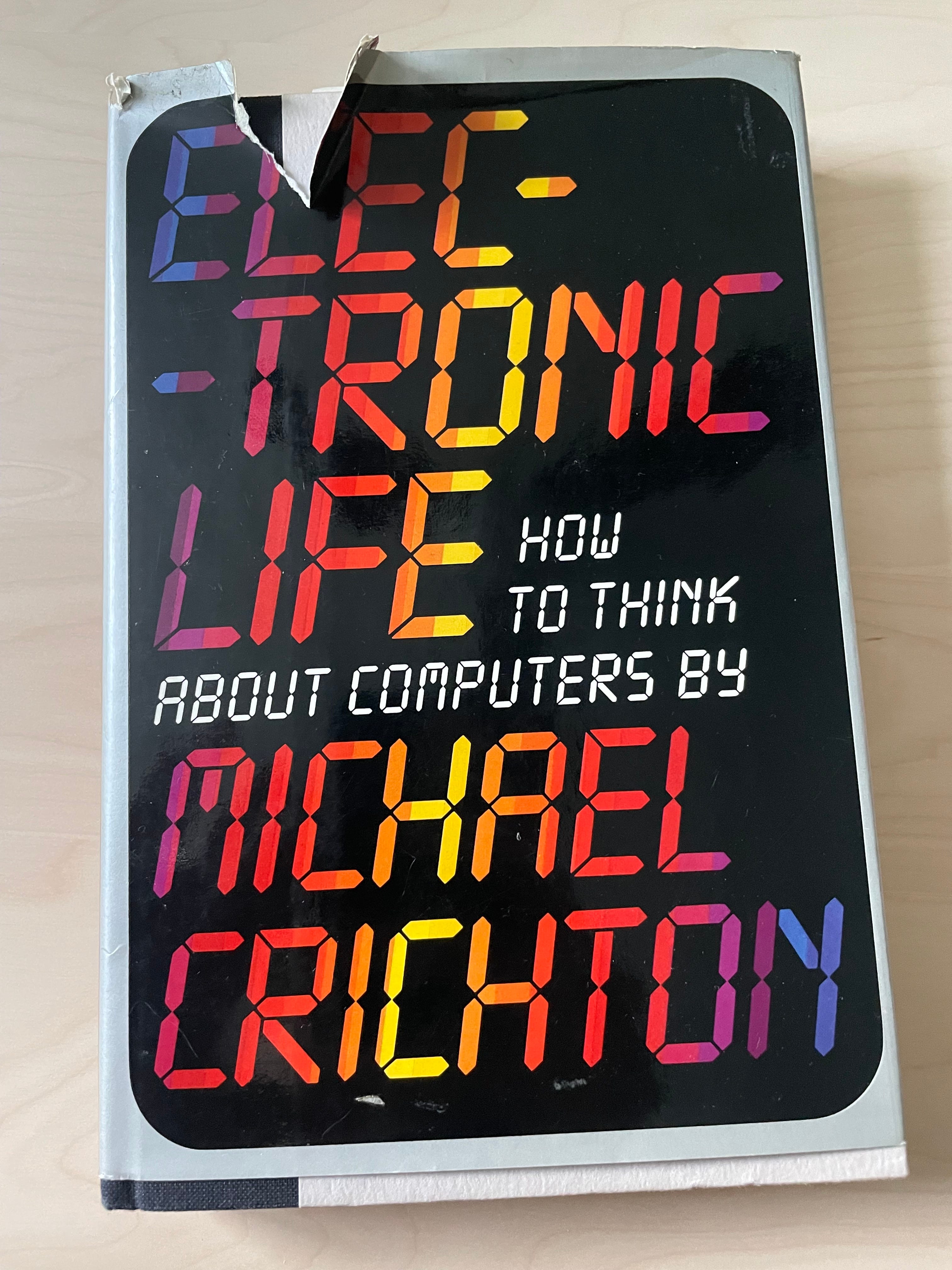
He figured he’d turn his notes into a book to help everyday folks figure out how to work, use, fiddle with, and think about computers. In 1983, many people were intimidated by and fearful of computers, fearful that computers might take away their livelihood, take away their jobs. Sound familiar?
The home computer arrived around 1977, so six years before the book was published. So it was a relatively new concept to buy a computer for your home. Crichton saw himself as someone who understood computers. In fact, the 1973 film Westworld, which he directed, is credited with being the first film to use computer graphics. It’s also credited with having one of the first instances of a computer virus in fiction.
Crichton is known for being prescient.
You’d think Electronic Life would feel oddly dated. And let’s be real, there are tons of ways it is. For instance, the appendices are code that Crichton wrote himself that users could use to tinker with their computers. But the common thread throughout the book is not just practical advice on how to use a computer, but how to think about computers. And this is where the book is still relatable today.
The practical advice may be moot, but the insights are surprisingly relevant.
The book is organized alphabetically like a dictionary, with titles like “Drive, Floppy Disk,” “Jargon,” or “Files.” The writing is that laid-back, straight-edged, Hemingwayesque style that Crichton honed over the years. Very direct, to the point, but compelling. Much of the writing has interesting analogies to help you better understand computers.
Such as this section titled “Down,” found on page 62:
“Computers, like boxers and airplanes, go down when they fail. They are also said to crash, or bomb out. The sudden violence implicit in such terms should be taken seriously. This slang originates with hard-core computer technicians. They know what they’re talking about.”
And there are quite a few prescient parts. For instance, Crichton predicts the iPad: “For example, there is talk of building memory into monitors, so that you could load text into your thin screen, unplug the screen from the computer, and go sit on the couch to read, as you now read a book.” Anyone who’s a fan of The Hitchhiker’s Guide to the Galaxy would recall that the guide itself is very reminiscent of the iPad, except that it required keys like an old BlackBerry. Do you remember the BlackBerry? Do you even know what a BlackBerry is? Crichton was more accurate in his prediction, or rather, he was aware of the research that would eventually lead to the iPad.
He discusses the fear of computers, which easily parallels AI: “Worried about losing your job to a machine? Most people are. Are your worries justified? That’s hard to say.” But he continues, “I have trouble with the doomsayers who foresee human beings on the soup lines and machines ladling out the soup. Nor am I persuaded by the image of everyone tripping through sunlit fields… while machines do all the work and create all the wealth for us.”
Now I can answer your question: “Why did you read a 43-year-old book about computers?”
Sorry you had to ask it three times.
I was curious about Crichton’s perspective on computers and was curious if parallels existed between computers and AI. There’s a lot of hype about what AI can do. And a lot of fear about what AI can do. Much of the AI hype feels new, but it actually isn’t. We’ve been here before.
History doesn’t repeat or rhyme, it plagiarizes.
Computers certainly disrupted the job market, but they also opened up new industries. I’m not saying that AI is good or that computers are bad. I’m saying don’t buy into the doom and gloom. And certainly don’t buy into the hype.
The book is prescient. In a way, timeless. It is an artifact of its time, but much of the thinking, the “how to think about computers,” can be replaced with “how to think about new technology.” For a 43-year-old book, it’s actually pretty darn relevant today.
The Verdict
Crichton’s perspective on computers is relatable, despite the 43-year difference between when it was written and today. This snapshot of the history of the home computer and the anxieties that Crichton attempts to quell from new users can be transposed onto AI, or really any new technology. I really enjoyed this book, learned a lot about computers I didn’t know, and it helped me reframe my thoughts, fears, and frustrations with AI. This gets a four and a half out of five, which I know is pretty high. I enjoyed this more than A Murder in Hollywood, which was published on May 5, 2026.
Rating: 4.5 out of 5 stars
★★★★½