

A Murder in Hollywood by Michael Crichton is a unique book. For one, for a book called A Murder in Hollywood, much of it doesn’t actually take place in Hollywood. In fact, the murder itself doesn’t take place in Hollywood. The second unique part is that this is the fifth book by Michael Crichton that has been published since his death. I can’t think of another writer who has been so prolific after death since J.R.R. Tolkien.
A Brief History
A Murder in Hollywood was originally written in 1973 and intended to be published under Crichton’s pen name, John Lange, a name he used for writing quick thrillers during medical school at Harvard. In the introduction by Sherri Crichton, Crichton’s widow, we learn a little about his use of pen names. Unfortunately, we don’t learn anything new, specifically the reason the completed manuscript was never published in the first place. This lack of context is the biggest disappointment of the book. It would have been nice to have a little more information.
What can be worked out is that 1973, the year the book is said to have been written, was the year Crichton’s film Westworld was released. This was the second film he directed, the first being the TV movie Pursuit, based on his novel Binary, which he wrote under the Lange name.
The timing of the composition of A Murder in Hollywood makes a lot of sense. A book about the struggles of filming a Western: dealing with know-nothing studio heads and egotistical Hollywood actors. The book has many details that only someone with the experience of working in Hollywood could have knowledge of. Crichton has explained before that Westworld was a trying experience. Perhaps this was a bit of catharsis.
But why didn’t the work get published in 1973? I have a few thoughts:
Maybe at this point in his career, Crichton didn’t need a pen name anymore. John Lange was behind him, and now, with The Andromeda Strain under his belt, he could focus on his work under his own name.
Maybe it was written for fun. Crichton had an idea and just went with it. Then, since it didn’t align with his plans or his future passions, he moved on, much like he’d later do with Hollywood.
It makes sense to be a writer struck with an idea and just going with it to see where it leads. Crichton has claimed he could dish out these books relatively fast; one was completed in nine days. As we know, he was very prolific when writing, constantly typing away until the work was done. He even ate the same thing for lunch every day while working, to save time and stick to a routine.
It would have been nice to have been provided with answers to these questions. People are interested and continue to be interested in Crichton’s work. I think it’s important to give some clarity to his loyal fans.
The Review
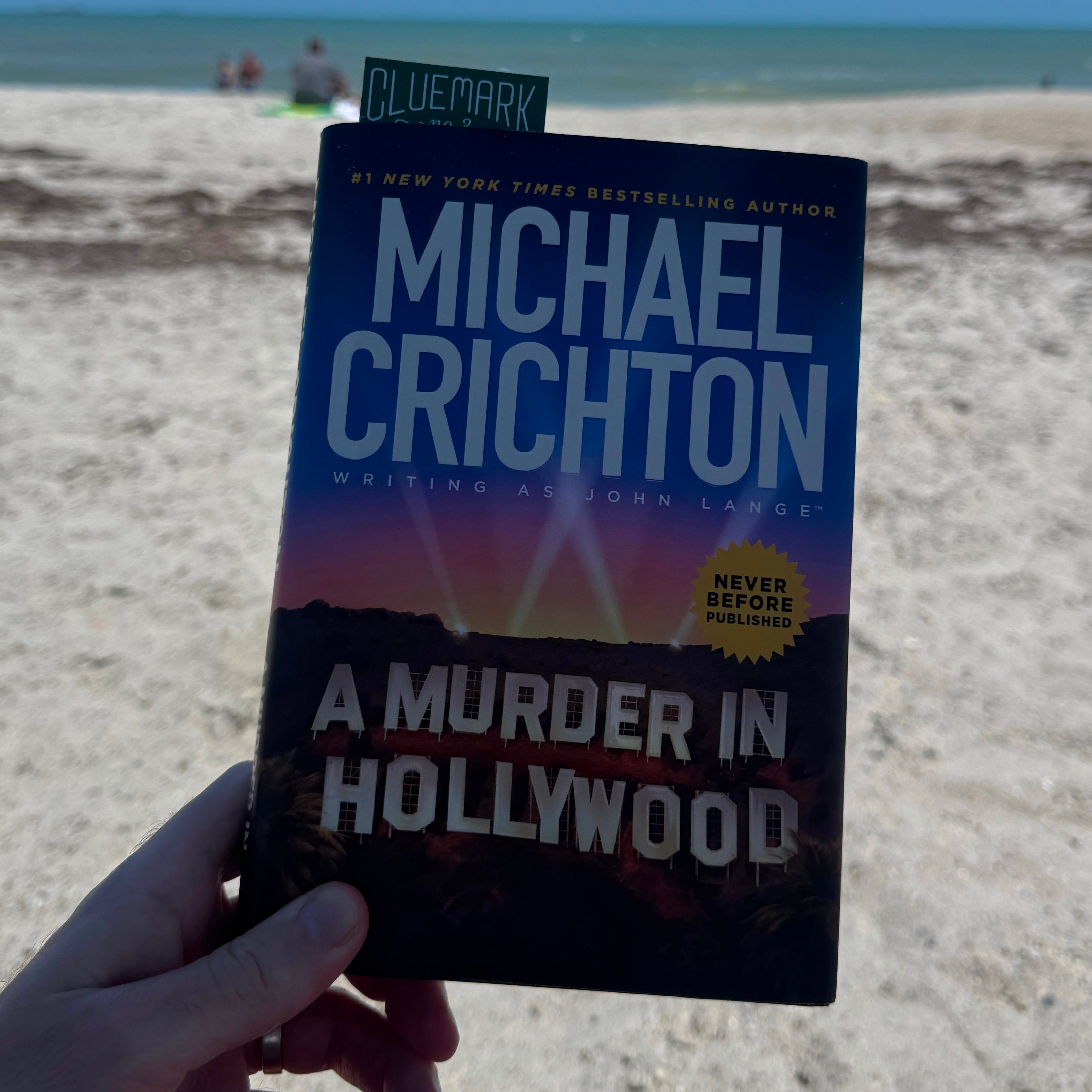
The book is a fun, quick read. I received my copy in the mail around 6 p.m. on release day and proceeded to finish it in two days. One of those days was spent on the beach reading. As a beach read, especially for summertime, I couldn’t agree more that this is the sort of novel that is made for reading on the beach. I wouldn’t say breezy, at least not until the end of the book, as it does take some time to get into. This is not the fault of the manuscript itself.
Before reading this book, I had read Rising Sun another work by Crichton. I also struggled to get into that. Both are mysteries. As someone who currently has a mystery on submission with my agent, I can attest that mysteries take time to unfold. However, one fun aspect of this novel is that it already opens essentially with the murder.
The story takes place on the film set of a Western called “Bloodrock.” It’s narrated by Harvey Jason, the unit publicist on the film. By page 6, we learn that the lead writer has been found dead in his bathtub. Originally, its thought to be an accident, but we soon learn fingerprints had been wiped away from the crime scene, leading people to assume that it was a murder after all. There are several suspects, Clete Williams, the lead of the film, being the number one. As the leading man, you can imagine the media frenzy.
The studio calls in a special auditor by the name of Harlow Perkins. Because Jason is the publicist, he has to deal with Perkins and essentially becomes Perkins’ Watson. Harlow Perkins is meticulous in every detail, down to his dress, which is formal and neat, and not the sort of thing you’d expect someone to wear in the 100-degree weather of Tucson, Arizona.
Perkins is your typical genre detective. He has peculiarities, to the point that he feels like a cross between Sherlock Holmes and Hercule Poirot. No doubt, the initials H.P. are a reference to Agatha Christie’s famous detective. There’s a scene where Perkins expertly taps open the top of a boiled egg, reminiscent of, if not an homage to, Christie’s detective. Like Holmes, Perkins keeps his suspicions to himself. Like Poirot, he has a show of solving the case.
Without spoiling the story, the book builds at a modest clip. By the last 100 pages, you can’t put it down. Like Crichton’s other books with the Lange pen name, the ending twists and surprises, which is exactly what you want out of a mystery.
The writing style is personable, always referencing the reader with phrases like “I’m sure you remember hearing about…” and “If you’ve ever had…” Jason, as a narrator, has much more personality than most other narrative styles of Crichton’s later works, specifically thinking of Rising Sun, which was also written in first person. However, Jason is much more subjective in his assessment of situations, and we get to know him, and his personality reads through the text much more so than Peter Smith in Rising Sun, which, at times, makes it easy to forget it’s even in first person. That was not the case here.
The Verdict
There’s a lot that could be critiqued in this manuscript, but overall, as a mystery novel written in 1973, it’s fun. I’d give it four out of five stars. It was an engaging read, and as a mystery enthusiast, I think it does a good job of building suspense, dare I end on a cliché, and keeping the reader guessing.
Rating: 4 out of 5 stars
★★★★☆
I have just read it. I think there are a couple of major errors that an editor should have picked up and that show that the manuscript wasn't ready to be published.
1. Perkins explains that Mann tried to get rid of a film reel in order to avoid being connected to the murder, but this is not possible, as the murder had not happened yet when he got rid of the reel at the gas station.
2. Perkins asks Jason to organize his evening with three meetings at 7, 8 and 8:30. These times are not kept at all but still it is said that they were "right on time" when they get to the last one. I think the times should have been 6, 7 and 7:30 - that may have worked.