

The first book Michael Crichton published under his own name, The Andromeda Strain, became a massive success, jumpstarting Crichton’s career, and further solidifying his decision to leave medical school. As he writes in Travels:
Then, in my last year of school, it became publicized that I had written a book called The Andromeda Strain and sold it to the movies for a lot of money. Overnight, I was identified as a successful writer, and it changed everything in my life.
The success of the novel cannot be overstated, and the timing of publication was perfect. The Andromeda Strain was published on May 12, 1969, just over two months before the Apollo 11 Moon landing on July 20, 1969. The fear that some extraterrestrial pathogen could be carried back to Earth was not just a fictional premise. NASA had thought about this and had set up strict quarantine procedures for the astronauts. Crichton was in lockstep with the zeitgeist.
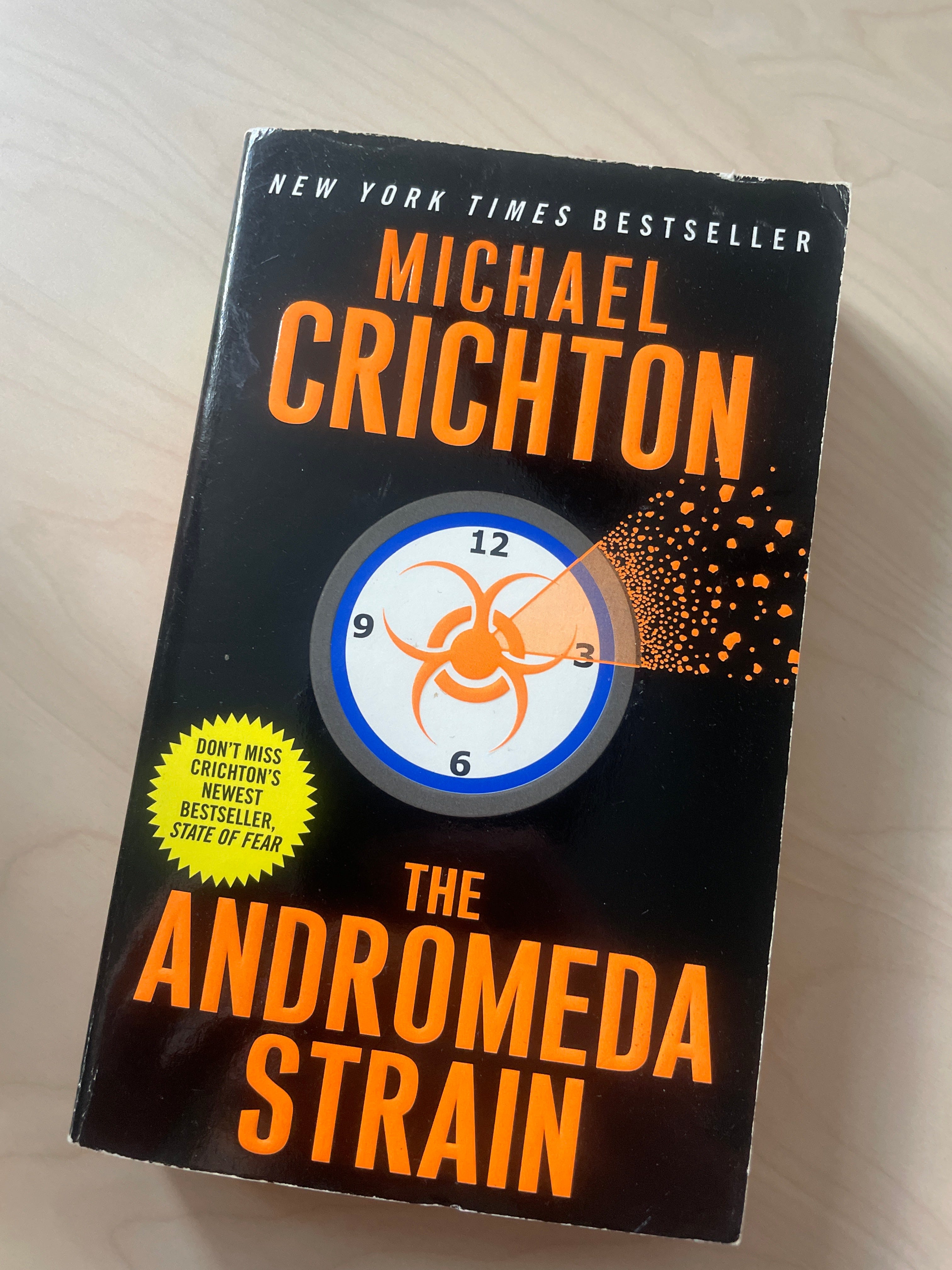
What further made the novel stand out was that it was written as though it were nonfiction. It reads as a deeply researched classified report. As Crichton told The New York Times in 1969, “I found you could make something more believable if you pretended not that it might happen or was happening but that it had happened.”
This specific framing device was at the suggestion of Crichton’s editor, Robert Gottlieb, who saw potential in the first draft but felt it needed to feel more real. As Crichton tells it, “Bob said that the novel should read like a New Yorker profile, that it should be absolutely convincing.”
And so it was.
A Brief Synopsis
A satellite crashes into Piedmont, Arizona and releases a deadly otherworldly microorganism, killing everyone in the town except for an old man who drinks too much and a colic baby. From there, a secret team of scientists investigate the spread in a covert facility in the middle of a desert, and try to contain it, all while working against time to ensure the organism doesn’t spread.
You can see the seed of themes that run throughout Crichton’s work. The satellite that releases this pathogen was part of a secret military program to further biological weapon research. Like Jurassic Park, The Andromeda Strain suggests that nature cannot be controlled. As Ian Malcolm warns scientists are “so preoccupied with whether or not they could” that “they didn’t stop to think if they should.”
The Style
It does read as though it actually happened. Though this is an earlier work of Crichton’s, if not the earliest, if we ignore the pen names, you can see the germs (no pun intended) of his later style. But this is also its weakest element. Because of the nonfiction narrative style, you don’t feel the necessary urgency; you’re pulled back from the story and the characters. You’re also aware that the world does not end, since this is a classified file. I mean, who could classify a file if the whole world ends?
Instead, much of the novel is focused on building this sense of reality, focusing on every minute detail, going into asides that feel too overwrought, background information that doesn’t feel pertinent to the story, but that continues to build the world without necessarily advancing the plot. Science is mixed with reality, to the point that even at the end of the novel there’s a bibliography.
Initial Thoughts
I thought it’d be interesting to add my initial notes I wrote right after reading the novel and then further elaborate. Here’s what I wrote:
Slow start. Too technical. Fairly decent ending, particularly the countdown sequence; this was fairly predictable, though. The more interesting part was the idea itself, and the development of the plot. You can tell Crichton is a… or rather was a doctor. The seeds of the Sphere are clearly here. Sphere is significantly better.
Slow Start
I’ve tried to read The Andromeda Strain for nearly 20 years. As a huge Crichton fan who has read nearly every single one of his books, it’s honestly embarrassing I haven’t read the book that made Michael Crichton a household name, and solidified not only his thriller status, but him as the forefather of the techno-thriller.
But, I found the novel slow going, and multiple attempts over the last two decades have continued to prove this out. Finally, I was able to get through it. What changed? The audiobook in conjunction with reading. That helped get through the slower bits.
The story opens with a military recovery team searching for a fallen satellite in Piedmont, Arizona. The town appears empty at first, until they begin finding bodies. Before they can make sense of what has happened, the small recovery team dies. From there, the novel focuses on the military response and Major Manchek, who activates Project Wildfire. Much of the next stretch of the novel is buildup: assembling the scientific team, explaining Project Wildfire and everything in between.
During the setup (which seemingly lasts forever) the plot takes a backseat to world building. This is what I mean by slow. To build the “reality” we are subject to so much detail, history, and science that the plot really doesn’t progress much.
Too Technical
As I said, the technical issues. It discusses the different levels of the building that was designed specifically for this project. From the color that each floor is painted (“Yes,” Leavitt said. “All levels are painted a different color. Level I is red; II, yellow; III, white; IV, green; and V, blue.”) to the “seductive” voice used for the automated medical machine (“The voice,” said the supervisor heavily, “belongs to Miss Gladys Stevens, who is sixty-three years old.).
You can tell Crichton’s still working out how to add technical and scientific information into a novel in a way that doesn’t slow down the story. Here, it slows down the story.
Predictable
There are a lot of elements that weren’t predictable. Crichton introduces many questions that need to be answered and he does answer all of them in a satisfactory way. Such questions as:
What is the pathogen?
How did a baby survive when the townsfolk did not?
How did an old man with a bad stomach survive when others did not?
What do the two have in common?
However, the facility contains a nuclear bomb that will detonate within three minutes if there’s a lab leak. Dr. Hall is the only one with the key to make the decision to switch if off. Because of this emphasis throughout the story, you know that the novel will likely end with that countdown. It’s Chekhov’s Gun (or rather, Chekhov’s bomb).
But that predictability does not diminish the chapter “Three Minutes” suspense, which was an edge-of-your-seat affair. Honestly, the best part of the book. This suspense is absolutely reminiscent of later Crichton thrillers, except in later novels the suspense is not contained in a single chapter.
The Verdict
The Andromeda Strain has a great premise and plot, but the execution was lacking due to the constrained limitations of its conceit, non-fiction, leading to over-explanations, and under utilization of story progression. This is a solid three point five. However, Crichton does showcase his unique ability at creating a page turner, even in this early novel, once you get through 90 percent of the book. If you want to read a book about scientists working together to solve a unique alien-related problem, then I highly suggest reading Crichton’s Sphere, instead.
Rating: 3.5 out of 5 stars
★★★½
Sources
Crichton, Michael. The Andromeda Strain. New York: Vintage, 2012.
Crichton, Michael. Travels. New York: Alfred A. Knopf, 1988.
Shenker, Israel. “Michael Crichton (Rhymes with Frighten).” New York Times Book Review, June 8, 1969, 5, 40.
Michael Crichton Official Website. “The Andromeda Strain.” https://michaelcrichton.com/works/the-andromeda-strain/.
Jurassic Park. Directed by Steven Spielberg. Universal City, CA: Universal Pictures, 1993.