

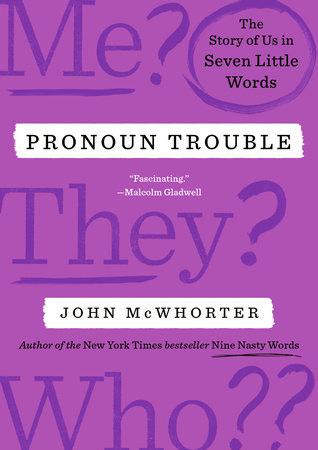
“Pronoun Trouble” is the second book I’ve read by John McWhorter after “Words on the Move,” and the fourth work of his I’ve engaged with, after two lectures I listened to as part of The Great Courses series.
This one was a fun read and listen. You learn a lot about how pronouns have changed over the years. For example, “I” used to be something like “eg.” It’s totally fine to use “Billy and me went to the store” and not “Billy and I went to the store,” since this often pedantic issue runs up against basic logic when examining usage. In Old English, “she” used to be “heo,” which used to be too similar to the Old English word for “he,” “he” (talk about confusing). McWhorter also gets into “thou” and “you,” including Shakespeare’s use of them in “Othello” to indicate social status, familiarity and belittling.
One interesting anecdote is about nicknames. In Middle English, “mine” was used before words that started with vowels in place of “my.” So “my Ed” was “mine Ed,” and over time, that “n” became attached to “Ed,” giving us “Ned.” This process is called rebracketing.
And of course, a very enlightened view on “they” culminating in McWhorter doing what he says linguists don’t normally do: give usage advice. He says we should use “they” as though it were singular when referring to one person in all regards, including in this construction: “she/he/they wants.” Currently, we’d say, “They want to go to the store.” But if “they” is singular, “they” should follow the same construction as “he/she wants.” So, it should be, “They wants to go to the store.”
McWhorter is self-aware that he’s sometimes seen as contentious, but he’s level-headed, not a language curmudgeon but a realist who understands language changes. That is the distinction between linguists and pedantic linguaphiles who cling to words and older meanings when language is always on the move.